Monday, September 9, 2013

The Many Faces of Swords & Wizardry

I first picked up on the Swords & Wizardry vibe back in 2009 when I was exploring the blossoming OSR*.  I had looked into Labyrinth Lord and Basic Fantasy at the time but there was something about the title of Swords & Wizardry and the beautiful Peter Mullen art that really captured the game for me - the game I remember playing in my head as well as the game I wanted to begin playing again.

I had picked up the PDF version of the 1st edition S&W rules (along with LL and BFRPG) and was hooked.  It was the perfect set of rules for me.  Direct and to the point and a nice handful of pages, clear and concise and open for plenty of expansion and very much the same game I stared out with (Holmes).

Swords & Wizardry evolved of these brief years.  Since our S&W campaign is starting back up again this week I thought I'd take a look at the gallery of S&W rules.

The first S&W rule book I worked with back in
early 2009. Peter Mullen's cover art captured dungeon
exploration to in but a single picture and a thousand
words - including the troublesome halfling.

Little did I know that once I received my first copy
of S&W were the Core Rules in production and
soon released. This is the rule-set we've used for
our ongoing S&W Campaign
If S&W Core wasn't 'Old School' enough,
White Box brought the rules back to their most
basic form including d6 weapon damage for all
weapons. Another beautiful Peter Mullen's cover.
Frog God released the Complete Rules.
It would take me all these years to jump on the
Complete wagon we I had house-ruled
most other classes into our Core game.
Swords & Wizardry White Box was release as, well,
a white box.  A handful of little white books in a
little white box recreated the little brown books in the little
brown box from waaaaay back.
Updated White Box single book edition.
Finally, modern times with the current Swords &
Wizardry Complete Rulebook. We have finally moved
our campaign over to these rules.  I'll be talking about
more about this rule-set later this week.
After a major hiatus from our Swords & Wizardry campaign (last session played in January), our group is once again taking up blade and dice to see what trouble can be had around the gaming table.  Look for new Session Updates to be posted soon.

*Now I know that tons of folks were still playing the original versions of the games as can be proven by the Dragons' Foot and the OD&D boards where I had frequented a year or two prior.  But with the so called explosion of these Retro-Clones the border for the 'Revival' had been drawn.

Tuesday, August 6, 2013

Roll 20 And Playing In A Virtual Environment Part 3

So with all the preparations completed, I was ready to run my first Virtual Table Top game via Roll 20.

The Game Session

With a small group of decent role-players lined up we all connected and started playing.

Roll20 has some nice features, one of which is the addition of background adventure music controlled by the GM.  I have always felt that one of the roles of being a GM is in setting the session mood and atmosphere.  With the background music (and sound effects) that you can control I thought this would be a great feature, and it is, however, for a first session, there's quite a lot to manage on a VTT.  By the time you've switched to a different scene, got all the player's tokens moved over and positioned, got your notes ready, the background music falls a bit down the priority list.  I think with more practice and experience running a Roll20 VTT session, managing the music would become easier, but initially, it's one extra thing to have your hands on.

We gathered together via voice only chat using Skype.  I've never been a huge Skype fan as I have always found it glitchy but I thought that not using the video portion would improve it's functionality.  Well, it didn't.  More than a couple of times we lost one player here and there and they had to reconnect.  And at the end of the session - the wrap-up, I lost all Skype connectivity.  Which made it a real hassle to get back on with everyone just for planning next session and 'see ya laters'.  It took longer to get everything connected again than it did to 'wrap things up', one of the things that annoy be about technology in general.

Why I didn't go with Google Hangouts?  I guess I was worried about computer performance but with all the Skype issues I had over a three hour session - which wasn't too many - but it intrupts game-play as we 'look' around for a missing player, I'll probably go with Google Hangouts in the next session and see how that goes.

The Gameplay Itself

Sitting around a table you have faces to interact with.  A face to face conversation or storytelling is a bit more enveloping and interactive than over the interwebs.  It took me a while to get use to just talking into 'space' even though players were floating within that space.  It was a bit tricky placing a disembodied voice with a PC or token.  I had a couple of nice distinct voices to separate but I constantly had to ask who was talking for which PC.

Again, talking into space took awhile to get use to but play moved along.  The screen did become, at least for me, the hub of what I connected with, something to keep my eyes occupied while we chatted and played.  Getting over that, the gameplay progressed as any other face to face session might.

The game mechanics within the Roll 20 VTT itself worked flawlessly.  Dice rolling was a snap, along with keeping track of hit points, which was linked between the tokens and the player's character sheets. Combat moved quickly with the system as well.

The lower basements as explored by the players. 
 Letting the players move their tokens around the map was nice too.  It made my job as GM easy in terms of knowing where everybody was at any given time.  In fact, what I discovered was that the players interacted with the map way more than they do in a usual face to face session.

For example, players would point to items they saw on the map and asked what they were and examine and explore the environment that way.  They were using the dungeon dressings that I placed on the map page as what they actually saw and relied less on my descriptions.  It caught me off guard a bit but it's something worth noting.  With some of the points I made about map-making in my previous posts, and how the more detailed maps would pull the game out of a players imagination and focus it onto the computer screen seemed to hold true.  The more detailed map played in this virtual table top changed an important element of the game.  I'm not going to judge it as bad or good, just different.  And I think I would adapt my GMing style a bit to accommodate that change.  If I were to continue playing with these detailed maps, I would be sure they are way more accurate knowing they were to be used by the players more as a way to interact with the environment in the game session.

Conclusions

Overall, I have to say that the VTT gaming experience was pretty good.  It's different than a face to face session, without a doubt.  It does present different challenges running a session.  Adding a layer of technology can make a GM's job that much more complicated, but with some practice some of that can get ironed out.

I was surprised by how the players interacted with the maps and what they saw on the VTT screen and that brings up the biggest point - would one pursue that direction of controlling the VTT experience by letting the players explore more of what they see and less of what they hear from you as GM or strip all that away and use the VTT more of a blank slate to project your imagination onto?  I think the VTT can work either way.  There would be a lot less prep time  if you just used the drawing tools to draw maps on the screen on the fly as needed and NOT use the VTT as the be-all end-all environment with which to play.  Use it as a blank table.  It would be just as easy to play the sessions in a full detailed mapped out environment, though slightly different than what one might be use to.  The differences are subtle but they are there.

I do know that if I were to run an ongoing campaign, especially sandbox style, I would not spend all my free time preparing for a session by creating detailed maps and populating those maps ahead of time to be imported into a VTT system and used as a what you see is what you get game-board.  Free-form sessions usually never work like that.  I would go with the former method of stripping down the VTT game play area, leaving it open to be used only when needed, much of how my table-top sessions usually run - pulling the minis out only when needed.

I'll probably finish the game as I had intended and created, as a fully detailed game play map but I would like to try the VTT in a more stripped down version that I'm more use to.  Roll 20 VTT should easily adapt to those different styles and anything in between.  Me, I'll just keep rolling with it until I find that perfect sweet-spot on the Virtual TableTop.

Read part 1 and part 2 

Thursday, August 1, 2013

Roll 20 And Playing In A Virtual Environment Part 2

Part 2 of my experiences with running a session, from an old school perspective, in a Virtual TableTop (VTT), specifically Roll 20.

You can go through your own research, walk-throughs and toying around with Roll20 if you haven't already. I think you'll find it pretty robust.

You can also catch up on Part 1 here.

Preparing the Session Part 2

With the VTT maps completed I began to populate the dungeons with our familiar denizens.

Now the standard VTT maps, when created, tend to have a video game quality to them;  an overhead view of a semi-realistic portrayal of the dungeon environment displayed upon the virtual table.  My main concern was that this display would pull players out of their imagination and stick them within the computer screen.  Don't know if that was good or bad but, instinctively I felt that was something I would try to avoid.  So when it came to adding the monster tokens I was faced with another decision.

Since the maps are top-down views, the tokens for monsters and players tend to also be from a top down view.  This also pushed the visual experience of a VTT into a realm of a video game.
VTT monster tokens
Overhead, I don't know what monsters are going to kill the party!

It also made it hard to tell what monster you were actually facing.

I decided to go with using token rounds that I customized and created from old-school art.

VTT monster tokens
More representative monster tokens.  Ah, goblins are going to kill the party!
I think these had a better feel to them, at least for me.  But what I also felt was that the more realism I pulled out of the graphic represented on the screen, the more my imagination fill that space in.  This lead me to the conclusion that I can probably pull out all 'realism' from the map as well and that would let player's imagination participate more.

Since I had already created the maps, I left them as is as I wanted to experiment with using the VTT in this visual extreme.  So I ended with detailed maps and hand-drawn tokens.

Gathering Players

I posted my campaign session out there on the Roll20 Boards to gather players.  I was running Swords & Wizardry Complete with my updated house-rules.  I was hoping an old school set of rules would bring in some curious players. I decided I would take the first 5 players that responded.  I was open to playing with veterans or players new to RPGs alike.  Basically I just wanted to see who would show up.

It only took a day or two to get six interested parties, one over what I had planned.  I thought, why not challenge my first time running a VTT session.  Six players at my real table, though rowdy is quite fun.  I also figured that by game time I would loose one or two players for whatever reasons would come up - and that was indeed the case.  One player took himself out of the mix while the other just never responded or replied after their initial poke of interest.

So I ended up with four virtual players, all of whom were pretty decent role-players.

Since Roll20 VTT's game sessions, once activated, can be used by the invited players whether the GM is present or not.  So we worked out character creation where they would make their attribute rolls in game, which records all the dice rolls and used the message board for CharGen and rule questions.

With everything in place, I was finally ready to begin playing...

Part 3

Tuesday, July 30, 2013

Roll 20 And Playing In A Virtual Environment Part 1

I love the concept of a Virtual Tabletop (VTT) for playing RPGs.

Playing with folks from all over the interwebs or old friends in different states, with all the tools, from dice rolling and minis and maps, make the VTT a great 21 century tool for Role Playing across the void of time and space (okay, that was a bit more dramatic that what I was actually going for but you get the idea).

Over the years I've browsed through Fantasy Grounds, Open RPG and a couple of others (you can see a full list here).  But what I found with these is a large learning-curve, cost for the application (usually for the GM), or platform specific (yeah, I'm on a Mac).  I had no intention of making my job as GM more complicated than it already was.

Then I came across Roll 20  a while back.  Roll 20 is a browser-based VTT, that is both non-browser and non-platform specific, has a much smaller learning-curve, and a responsive development team.  And one other thing is that it's free to use.

You can go through your own research, walk-throughs and toying around with Roll20 if you haven't already. I think you'll find it pretty robust.  What I really want to talk about is my experiences in preparing and running a Roll 20 game with an old school perspective.

Preparing the Session Part 1

As most of you know, as a GM, there is plenty to gather and organize for any gaming session.  A session in a VTT where you want to take full advantage of the application's tools is a whole additional process. 

There are many different ways to play a session on the VTT.  One is to just use the app for the group dice rolling, the other is to just import a scan of the map and reveal it as the players explore.  Another way is to build the scaled detailed map using the mapping tiles and populate the map with all manner of dungeon dressings available.  I choose to go with the later and experiment with the full process of the Virtual Environment created by the VTT.

Modern gaming usually has a smallish 'battle-map' that leads to the big-boss fight.  The scale of these 'adventures' is pretty small compared to mega-dungeon or free-form sandbox of old style of play.  And, of course, I was going for the later with a multi-level smallish megadungeon.
Virtual Tabletop map for Roll20
One of 2 Upper Level maps created.


In Roll20 you have all the tools in game to create a map or maps ahead of time and so I set out building my dungeon.  I decided to run my Outpost on the Edge of the Far Reaches adventure module and began translating that into the Roll20 table-top environment.  I began building the map directly in the application, which is fine for smaller encounter based adventure but for megadungeons can pose a bit of a problem with the number of images that has to be generated by the online application.  All the individual floor tiles, props and monsters all take time to render and can potentially slow the game down.  I later found that it is better to create your maps in an outside application such as Photoshop or GIMP.

Now, it does take a while to create one of these maps and I'm looking at created four or more of them in the VTT style.  But I chugged away at it and I eventually finished and imported the maps into the campaign.

My main concern was that in traditional table-top play - old school style, battle maps and minis rarely came into play.  The game mostly rides on the imagination of each player.  I began to wonder if these overly detailed maps might take away from the game being played in the mind to the game being played on screen.  I couldn't predict how that would go but I was surprised at how the players interacted with the detailed map.
VTT Cavern Map
One of 4 lower level maps created.

Roll 20 supports a fog of war feature that lets you reveal map areas to the players as you see fit.  They also support a Dynamic Lighting feature (for paying users) that let you 'program' how a torch light would interact with the environment.  Again, that would add another level of prep time for the GM and all within the VTT itself.  Since I'm playing with the free version, the fog of war is all I have to play with and that's plenty.

With the maps created, I moved on to populating my virtual dungeon and I'll cover that tomorrow in part two.

Part 3 can be found here.

Friday, June 28, 2013

Best Movie About Role-playing: Westworld

Guide to role-playing
Back in the early 70's there was a small explosion of some true to genre science fiction films that Hollywood was cranking out, no doubt due to the success of 2001: A Space Odyssey, and The Planet of the Apes (which spawned four sequels).  Films like Death Race 2000, The Omega Man, Silent Running, Soilent Green, Logan's Run, Rollerball and many others.  These were true Science Fiction stories, and like all good true science fiction, posed questions about man's relationship to himself, the universe and machines.  All of this was shattered in 1977 when Star Wars, a science fantasy film, rolled over the genre like a Jawa Sandcrawler.

One of those early 70's sci-films was called Westworld a film about a resort that, for one thousand dollars a day, you can live out your fantasies in one of three fully-immersive environments, Medievalworld, Romanworld and Westworld.  The movie was written and directed by Michael Crichton (Jurassic Park, Andromeda Strain) and introduced his 'theme-park horror story'.  The twist is that all the other participants in these 'worlds' with the exception of the guests, are robots.  Of course "Nothing can go wrong".

So what does this have to do with Role-playing?

Westworld has all the elements and is a perfect analogy of a role-playing game.  Spoilers ahead, so if you need to go watch the movie do so now.

Players and PC rolled into one
The move starts with two guests, played by James Brolin and Richard Benjamin, head to Westworld to live out their fantasy of living a real wild west experience.  Brolin had been to Westworld once before (the experienced role-player), for Benjamin, however, this was his first experience (a role-player newbie).  Once they don their western garb provided by the resort Brolin kinda helps Benjamin through the ropes of getting into this role of a fantasy experience.  Benjamin has a hard time of 'letting go' and getting into the fantasy.

Bad-ass NPC
Their first stop, like any good role players, is the saloon.  Here they run into the antagonist of Westworld, the Gunslinger played by Yul Brenner who challenges Benjamin.  Here it's great to watch Benjamin's character, a Yuppie from Chicago, attempting to get into this fantasy role of cowboy and finally guns down Brenner.

Once the two friends loosen up to this 'new' fantasy world they do what any good role-players do; they start drinking, whorin' and shooting up the town.

Six-Gun's Enough!
It's really great how the first two-thirds of the movie parallels the general path of most players actions in role-playing games.  With a free open 'world' the first things that happens is that players, get drunk, whore around and cause trouble in the towns they visit.  A great point to note here is that after Brolin and Benjamin kill the sheriff in a jail-break, the role of sheriff of taken over by none other than Dick VanPatten, another guest with thick  glasses (totally out of place in the western scene) bumbling about.  A great visual of players entering these archetypical roles and projecting personae onto their characters.  In Medievalworld, the guest there hits on the queen and voluptuous wench while eating and drinking to his delight of a no-consequence world.

Keep in mind here, the guests are having sex with robots.

Hitting on the tavern robot ..er.. wench
The robots in the town are all the NPCs that the players (the stars of the story) run into. They are there only for the guests (players) interaction with their stereotypical roles and dialogue and simple purpose - to add life and color to the guest's (player's) experience of the world.

Your Game Master's brain
The robots are controlled by a master control center that represents the Game Master.  Here they re-program the robots on the fly to adapt to the guest's (player's) actions; altering their preconceived 'storylines' to please the guests (players), but also tossing in pre-programed events such as the bar-fight.  All fantasy RPG tropes are visited here.  Note that GMing on the fly is displayed by the technicians of master control, allowing the guests (players) to do what they desire but reacting to it and keeping it contained within the 'safe' notions of the control center (GM).

The guests (players) revel in their fantasies as there are no true consequences to their actions.  Killing NPCs, sleeping around, breaking the laws, the guest loose themselves in these actions but their feet are still rooted in their real world.  It's quite well captured this dual existence of the player and the PC.

Random roles really begin to start messing up everyone's
preconceived ideas of the session.
But here comes the third act.  Here the guests (players) and the control center techs (the GM) are surprised at what happens next.  And what happens next is the unexpected.  Here the random dice rolls take over and surprise both groups of participants creating this fantasy experience.  Within the movie, the robots start acting on their own and begin killing the guests.  In game terms, the random dice start rolling events and actions that neither player or GM were expecting.  Here the movie rolls into unexpected territory - unplanned and deadly.  The guests (players) begin reacting uncertainly for their lives, the techs (GM) does their best to roll with what's happening trying their best to regain control of their 'game'.

At this point enough reality seeps into the fantasy world to make it interesting, thrilling and deadly.  It is here that the lone survivor, Benjamin being relentlessly perused by the Gunslinger, runs 'off map' and into the other 'worlds'.  It is here that he gets his $1000 a day role-playing value!

I saw this movie when I was a kid and Brenner's emotionless robotic Gunslinger scared the crap outta me.  Watching this movie now, sure things seem dated but in a retro fun way, but watching this with the eye of a role-player was a revelation.  The movie is a perfect parallel to the RPG experience and worth spending an hour and a half watching.  If any movie needs a modern reboot, this is the one.

Never trust a robot to do a man's job.


Friday, June 7, 2013

Help Me Find.... Monsters!

UPDATED:  Case closed thanks to The Archmage and his Collection of Creepy Horrors!

Last month there was an A-Z blog festy thing.  Some great OSR blogger posted some really great monsters I believe he came up with.  Well, for the life of me, I can't find those  posts and I have no idea who posted them.  I was pretty sure I was a follower of his blog but for the life of me I can't track it down - because his monsters were really freaky and I want to use some to, you know, freak my players out.

Does anybody recall those posts...? 

Monday, June 3, 2013

Go Fer Yer Gun! Character Sheet

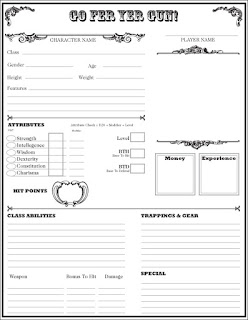
Always love tweaking character sheets and Go Fer Yer Gun! has been no different.  Here's the raw GFYG! character sheet for download.

Go Fer Yer Gun! Character Sheet